
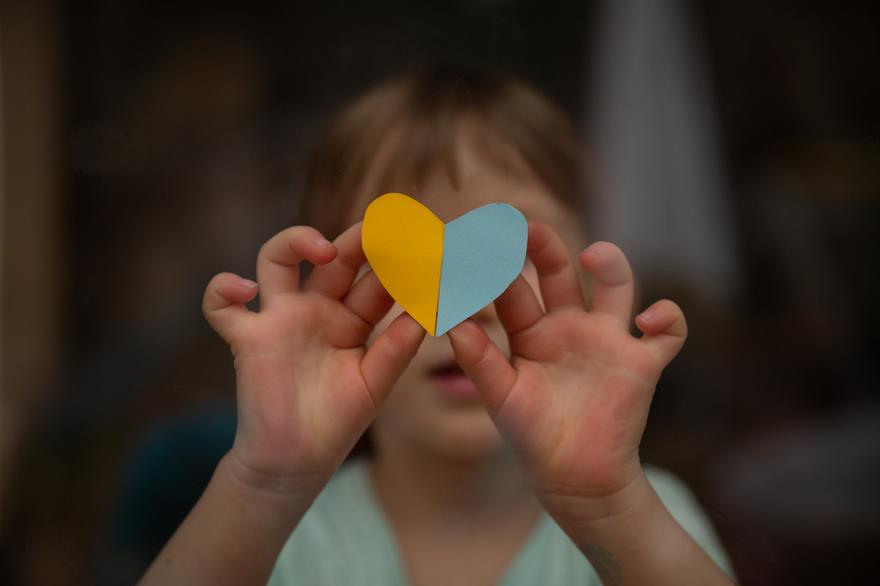
Millions of Ukrainian children and youth have been displaced since the Russian invasion, with a growing number of host countries reporting significant concerns regarding the well-being of these children. The devastating impact of war is taking a tragic toll on the very children their parents sought to save, despite the help of the welcoming countries to take them in. Can something be done to reverse this situation?
The key to addressing this problem lies in making sense of what has happened emotionally and attachment-wise to these children. All the signs indicate that these children and youth are failing to adapt to their circumstances. This is understandable but also disastrous. It doesn't have to be.
Humans have a remarkable ability to adapt, even to the most catastrophic circumstances, but this requires our brains to register emotionally that we cannot change what has happened. Simply put, only when this futility sinks in does it allow for the tears of futility to flow, which in turn transforms us from inside out, giving us the resilience to handle even the most unthinkable of circumstances. This has been the way of adaptation since time immemorial.
There is no need for anyone to adapt to that which can be changed. This is exactly the problem with this war. It is almost impossible to accept that it is happening, never mind that it is still happening. Over time, this renders us increasingly 'on hold,' so to speak; emotionally paralyzed. While we are waiting, the emotions meant to drive change become stale and foul, and the feelings of futility that would get our brains unstuck go missing. This is a 'perfect storm' emotionally; a condition that unfortunately tends to go undetected by almost all involved. This condition affects the adults as well, but it is the children we are trying to save here, and whose developmental potential is also now at risk.
When feelings of missing and sadness first disappear, we typically assume that the suffering has somewhat eased, and so think the child or adolescent is on their way to getting better. Few suspect that this eerie emotional calm is the proverbial calm- before-the-storm that will now progress to distracting symptoms of stuckness, struggles in learning, problems in behaviour, deficits in attention, and a general but devastating loss of well-being.
It is the initial loss of the tender feelings of missing that is almost always the singular tell-tale sign of the downward turn that will now take its emotional toll if not reversed. Instead of a missing that is fully felt, the child or adolescent becomes bored and agitated, or dejected and depressed, or even defended against caring. Many manifest all three sets of symptoms. These dynamics generate their own spiral of seeking endless distraction, flight from vulnerability, or numbing oneself in drugs.
The dilemma for caring adults is dreadful. To invite the child back to their missing feelings seems cruel, as that is where the suffering lies. As such, we are not likely to make headway even if we try. Battling against symptoms is ineffective as it doesn't get to the root problem. Getting such children to talk is often an exercise in futility. Arguing doesn't help; confrontation alienates; discipline makes things worse, and there isn't enough curiosity left to engage them in learning. This is where a tactical developmental retreat is required.
When distilled to the essence, there are only two effective antidotes for this emotional state. One involves relationships; the other emotional play.
Regarding relationships, our first priority should be to re-embed the child or adolescent in cascading care. This not only restores a sense of intrinsic meaning but is the most likely intervention to restore feelings of sadness. Only when a child is facing togetherness in the context of attachment will it feel safe enough for the child's feelings of missing to re-emerge. And once the heart softens to the point that the missing can more fully be felt, the futility of filling those gaping attachment holes with anything other than sadness becomes self-evident. Adaptation simply happens as a result. So rather than attempting to deal with the symptoms, we should focus on supporting the caring attachments that still exist for them, and supplementally or alternatively, matchmaking with other caring adults who are willing to get involved. The research is unequivocal on the powerful remedial role of a single emotional connection with a caring adult.
Regarding emotional play, it is when the brain is in the play mode that it becomes safe enough to feel, and the resulting suffering and sadness seem somewhat bearable. The emotional playgrounds I am referring to here can be anything, but more often involve the classic avenues of emotional expression that our cultures usually provide through music, stories, theatre, writing, dance, and drawing. Once the heart softens to where the missing can be felt, the rest of the recovery process tends to follow quite spontaneously and automatically. This kind of play therapy does not need to be structured or even observed for it to work. Quite paradoxically, play is most powerful therapeutically when those involved are the least focused on outcomes. Sometimes these emotional playgrounds are best accessed within one's culture and language of origin. I assume this would be quite true with the children of Ukraine.
In conclusion, we need to use relationship to draw these children into the emotional play they need, and we need to use emotional play to draw them into the cascading care relationships they need. I am convinced that all the available evidence points to these two paths as being the most promising. Play and relationship may certainly be embedded in formal programs but don't have to be in order to be effective. Fortunately, these two natural paths to well-being are universally accessible and, as such, do not require extensive expertise or special training to employ. By harnessing Nature's own answers to human adaptation, anyone who cares can ultimately make a difference.


